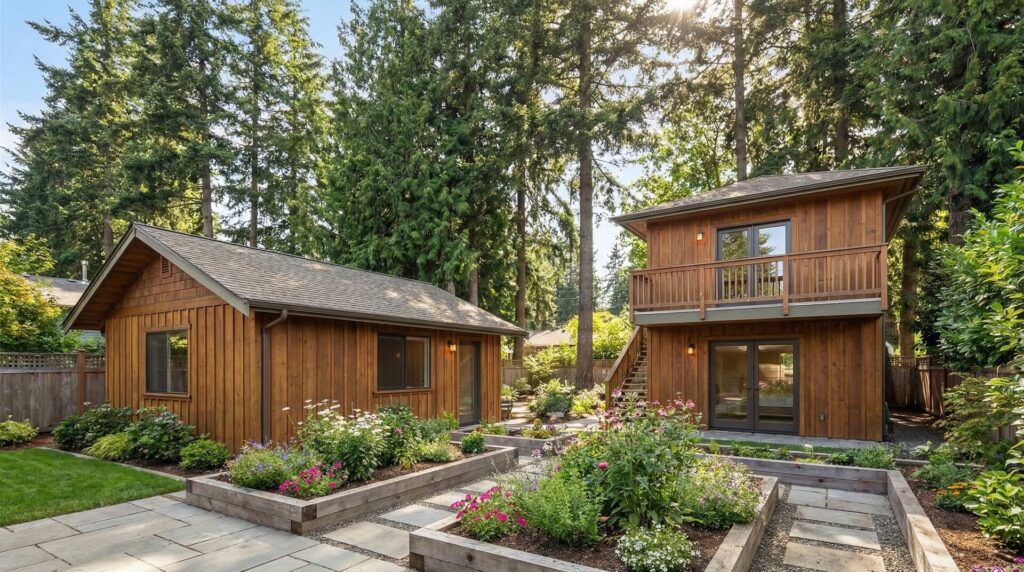
One Story or Two: A Fundamental Design Decision
Choosing between a single-story and two-story DADU is one of the earliest and most impactful decisions in your project. It affects your construction cost, lot coverage, livability, neighbor relations, and permit complexity. There’s no universally right answer — the best choice depends on your lot, your goals, and your budget.
Single-Story DADUs
Advantages
- Accessibility: No stairs means the unit works for all ages and mobility levels. Essential if you’re building for aging in place.
- Simpler construction: Single-story framing and roofing is less complex, reducing labor hours and structural requirements.
- Lower construction cost: Typically 10–15% less than a comparable two-story DADU due to simpler structure and no staircase.
- Less neighbor impact: Lower profile means fewer privacy and shadow concerns for adjacent properties.
- Easier permitting: Less likely to trigger height-related review issues.
Disadvantages
- Larger footprint: An 800 sq ft single-story DADU needs an 800 sq ft footprint. On small lots, this may not be feasible after applying setback requirements.
- More lot coverage: Takes up more of your yard, leaving less outdoor space.
- Less privacy between spaces: All rooms are on one level — less separation between sleeping and living areas.
Best Lot Conditions for Single-Story
- Lots 6,000+ square feet with generous buildable area
- Flat lots where a large foundation is straightforward
- Properties where height is a concern (neighbor sensitivity, view corridors)
- Projects designed for accessibility
Two-Story DADUs
Advantages
- Half the footprint: An 800 sq ft two-story needs only a ~400 sq ft ground floor, dramatically reducing lot coverage.
- Preserves yard space: More outdoor area for the property owner and tenants.
- Natural privacy: Bedrooms upstairs, living spaces downstairs — better separation of private and common areas.
- Small lot solution: Makes a full-size DADU possible on lots that can’t accommodate a large single-story footprint.
- Design interest: Two-story DADUs can have more architectural character and visual appeal.
Disadvantages
- Stairs: Not accessible for mobility-limited residents. Stairs also consume 30–50 sq ft of floor area on each level.
- Higher construction cost: Two-story framing, additional structural requirements, and a staircase add 10–15% to construction cost.
- Height restrictions: Must comply with base zone height limits. In some zones, a two-story DADU at the minimum setback may face reduced height limits.
- Neighbor concerns: Upper-floor windows overlooking adjacent properties can create privacy issues. Thoughtful window placement mitigates this.
- More complex permits: Height, shadow, and privacy considerations may add review time.
Best Lot Conditions for Two-Story
- Lots under 5,000 square feet where footprint is constrained. See our small lot floor plan guide.
- Properties where preserving yard space is a priority
- Sloped lots where a daylight basement can serve as the lower level
- Projects not requiring full accessibility
King County Height Rules
Height limits vary by zone but typically range from 30 to 35 feet in urban residential zones. Key considerations:
- Measurement method: Height is measured from average existing grade to the highest point of the roof.
- Pitched roofs: A two-story DADU with a pitched roof typically reaches 22–28 feet — well within most zone limits.
- Flat roofs: Reduce overall height by 3–5 feet compared to pitched roofs, making it easier to stay under limits.
- Daylight basements: On sloped lots, the exposed portion of a daylight basement may count toward building height.
Cost Comparison
For an 800 sq ft DADU with similar finishes:
- Single-story: $400,000–$600,000 all-in
- Two-story: $430,000–$650,000 all-in
The two-story premium comes from:
- Staircase construction: $5,000–$10,000
- Additional structural engineering: $2,000–$4,000
- More complex framing: $5,000–$10,000
- Second-floor bathroom plumbing: $2,000–$5,000
For a full cost breakdown, see our construction cost guide.
A Third Option: Single-Story With Loft
A single-story DADU with a sleeping loft combines some advantages of both approaches:
- Main living on one level (kitchen, bathroom, living area)
- Sleeping loft above with reduced ceiling height
- Loft area may not count toward the 1,000 sq ft maximum if ceiling height is below a threshold
- Maintains a smaller footprint than a full single-story
- Lower profile than a full two-story
Loft designs work best for younger tenants comfortable with a ladder or steep staircase — they’re not appropriate for accessibility needs.
Making the Right Choice
Ask these questions to guide your decision:
- How big is your buildable area? If it’s under 500 sq ft after setbacks, two-story may be your only option for a full-size DADU.
- Who will live there? Aging parents or mobility-limited occupants need single-story. Young professionals can handle stairs.
- How important is yard space? If you value your outdoor area, a two-story design preserves more of it.
- What’s your budget? Single-story saves 10–15% on construction if the lot allows it.
- What do your neighbors’ properties look like? A two-story DADU in a neighborhood of single-story homes may draw more scrutiny.
APEX DADU Designs for Your Situation
We evaluate every lot for both single-story and two-story feasibility before recommending a design direction. APEX DADU considers your lot constraints, budget, intended use, and neighborhood context to recommend the approach that delivers the best result for your specific situation.
Contact APEX DADU to discuss single-story vs. two-story options for your lot

Leave a Reply