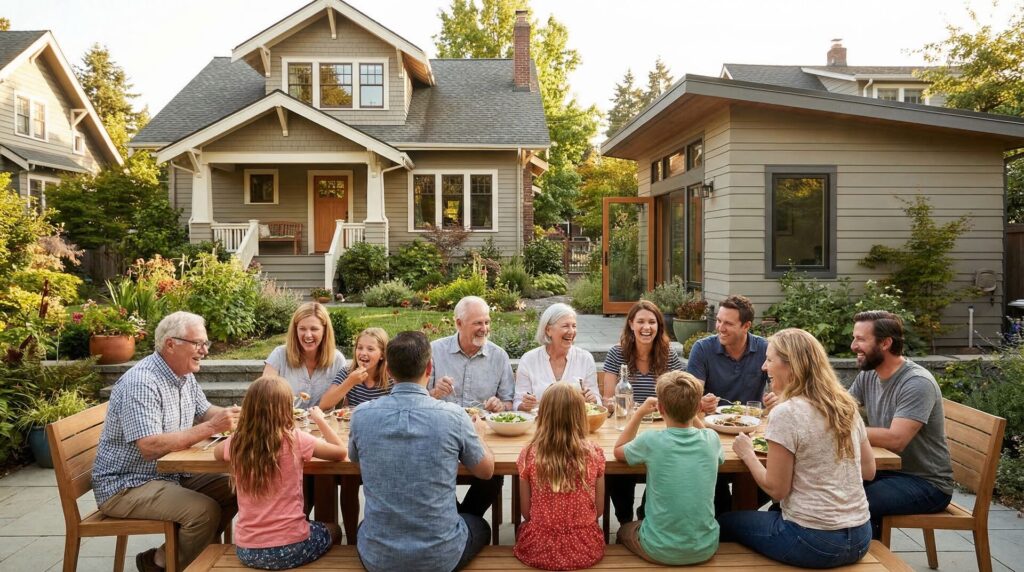
Family Close, Independence Intact
King County’s high housing costs have made multigenerational living increasingly practical — and DADUs make it possible without sacrificing privacy. A DADU in your backyard gives aging parents, adult children, or extended family their own complete home just steps from yours. It’s close enough for daily connection, far enough for independence.
This isn’t a new concept — multigenerational living has been the norm in many cultures for centuries. What’s new is how DADUs make it work beautifully in King County’s residential neighborhoods.
Common Multigenerational DADU Scenarios
Aging Parents Moving Closer
- Parents downsize from their larger home to a comfortable DADU
- Close enough for daily check-ins and shared meals
- Private enough for independent living
- Delays or eliminates the need for assisted living ($5,000–$10,000+/month in King County)
- Caregiver access when needed without live-in arrangements
Adult Children Getting Started
- Young adults can live affordably while saving for their own home
- Near family support while establishing careers
- Independent living space that feels like their own home — not the childhood bedroom
- Can pay below-market rent while building savings
Extended Family Support
- Siblings, cousins, or in-laws who need housing near family
- Grandparents who want to be near grandchildren
- Family members transitioning between life stages (divorce, career change, health recovery)
DADU Design for Multigenerational Living
Design choices that make multigenerational DADUs work well:
- Accessibility: Single-story design, wide doorways (36″), curbless shower, lever door handles. Design for aging even if the first occupants are young. See our aging-in-place guide.
- Full kitchen: A complete, independent kitchen is essential — not a kitchenette. Multigenerational privacy includes cooking independently.
- Separate entrance: Private entry that doesn’t require going through the primary home’s yard or common area.
- Visual privacy: Thoughtful window placement and landscaping between the DADU and primary home.
- Outdoor space: Even a small private patio or deck gives the DADU resident their own outdoor living area.
- Guest accommodation: A second bedroom or flex room allows the DADU resident to have visitors without relying on the primary home.
The Financial Case
Multigenerational DADUs make financial sense beyond rental income:
- Assisted living alternative: Assisted living in King County costs $5,000–$12,000/month. A DADU payment is often $2,000–$3,500/month (financing cost). The savings are substantial — potentially $60,000–$100,000/year.
- Property value increase: The DADU adds 20–30% to property value regardless of who lives in it. See our property value guide.
- Future flexibility: When family no longer needs the DADU, it becomes a rental generating $1,500–$3,000+/month.
- Shared household costs: Families can share expenses like childcare, meals, and transportation.
Making It Work: Boundaries and Communication
Multigenerational living works best with clear expectations:
- Discuss finances upfront. Will the family member pay rent? Share utilities? Contribute to property costs?
- Set privacy boundaries. When do you visit? When is each household’s private time? How much yard space is shared?
- Plan for transitions. What happens when circumstances change? Having a conversation early prevents conflict later.
- Keep it legal. Even with family, maintain proper documentation. The notice on title and insurance coverage should be in order.
APEX DADU Designs for Families
We’ve designed DADUs for multigenerational families across King County — from aging parents who need accessibility to young professionals who need independence. APEX DADU understands that family DADUs need thoughtful design that respects both connection and privacy.
Contact APEX DADU to discuss your multigenerational DADU project

Leave a Reply