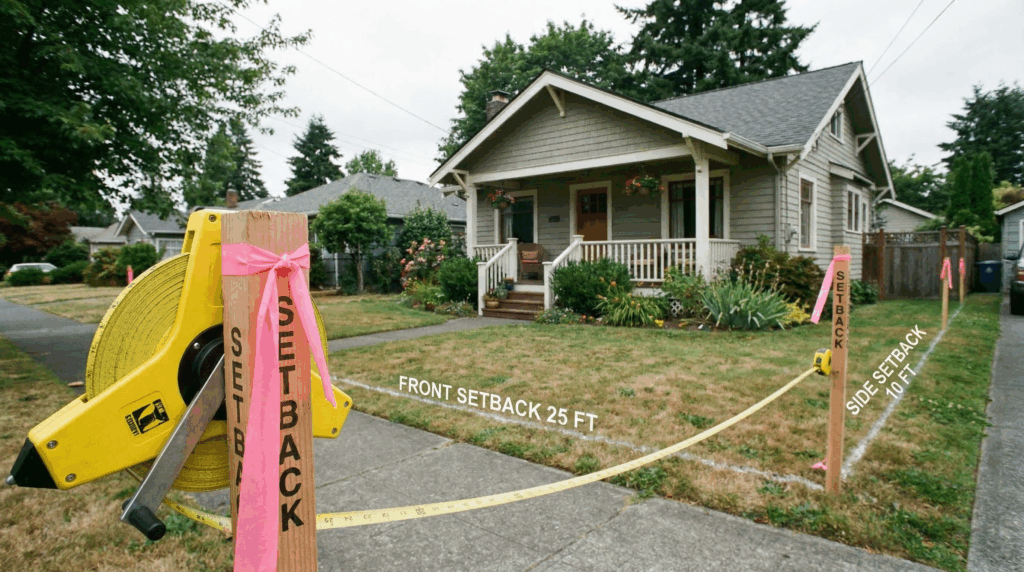
Why Setbacks and Size Limits Matter
Before you design a DADU — or even dream about one — you need to understand the physical constraints your property imposes. Setback requirements, size limits, and height restrictions determine where your DADU can go, how big it can be, and what it can look like.
Getting these wrong doesn’t just delay your project. It can kill it. A design that violates setback requirements gets rejected in plan review, and redesigning means starting the permit process over.
Maximum Size: How Big Can Your DADU Be?
King County sets clear size limits for detached accessory dwelling units:
- Heated floor area: Maximum 1,000 square feet.
- Unheated space: Up to 1,000 additional square feet of unheated space (garage, covered storage, utility room).
- Basement exception: Floor area in a basement of a detached ADU does not count toward the 1,000 square foot maximum. This is a significant advantage — a DADU with a daylight basement can effectively be much larger than the headline limit suggests.
For context, 1,000 square feet is enough for a comfortable one-bedroom or two-bedroom unit with a full kitchen, bathroom, and living area. Many successful DADUs are built at 600–800 square feet.
Setback Requirements
Setbacks are the minimum distances your DADU must maintain from property lines. King County’s requirements differ between urban and rural zones.
Urban Residential Zones
- Side yard: Minimum 5 feet from the side property line.
- Rear yard: Minimum 5 feet from the rear property line.
- Front yard (street-facing): Must maintain the same front yard setback as the primary residence. This typically means 10–20 feet depending on the zone.
- Between structures: There must be adequate separation between the DADU and primary home for fire safety and access.
Rural Zones
- Side and rear yards: Typically 10–20 feet, depending on lot size and specific zone.
- Front yard: Varies by zone, typically 20–35 feet.
Rural properties have larger setback requirements, but they also tend to have larger lots — so the buildable area is usually sufficient.
Important Setback Notes
- Measure from the property line, not the fence. Fences are frequently not on the actual property line. Always verify boundaries with a survey.
- Easements reduce buildable area. Utility, access, or drainage easements can effectively increase your setback requirements. Check your title report.
- Eaves and overhangs may project into setback areas by a limited distance (typically 18–24 inches), but the building wall must maintain the full setback.
- Decks and patios attached to the DADU have their own setback rules, which may differ from the building setbacks.
Lot Size Minimums
Not every lot in King County qualifies for a DADU:
- Urban zones: Minimum 3,200 square feet for a detached ADU.
- Rural zones: Must meet the minimum lot area for the applicable zone.
- Forestry (F) zones: ADUs are not permitted.
Most single-family residential lots in King County’s urban areas meet the 3,200 square foot minimum. If you’re close to the line, a precise survey is essential.
Height Restrictions
DADUs must comply with the base height limit for their zone. In practice, this means:
- Single-story DADUs: Typically 12–18 feet to the peak, well within height limits.
- Two-story DADUs: May approach or reach height limits, especially with steeper roof pitches. Careful design is needed to stay compliant while maximizing usable space.
- Neighbor impact: King County requires that DADUs be positioned to minimize impacts to privacy and views for surrounding property owners. Even if your design meets the technical height limit, the county may require modifications if the impact on neighbors is deemed excessive.
Designing Within the Constraints
Understanding setbacks and size limits isn’t just about compliance — it’s about smart design. Here’s how experienced DADU builders work within these constraints:
- Buildable area mapping: Before any design work begins, map the actual buildable area on your lot — accounting for setbacks, easements, and existing structures. This prevents wasted design time.
- Maximize the envelope: Once you know the buildable area, design the DADU to use it efficiently. Sometimes a slightly smaller footprint with a steeper roof pitch or loft yields more usable space.
- Daylight basements: On sloped lots, a daylight basement adds significant square footage without counting toward the 1,000 square foot maximum.
- Covered outdoor space: Covered porches and patios extend the livable feel of the DADU without adding to the heated floor area.
- Orientation matters: Position the DADU to maximize natural light and minimize neighbor privacy impact — both of which affect permit approval and rental appeal.
Two DADUs on One Lot
King County allows up to two ADUs per lot. If you’re considering two detached units — or one attached and one detached — the setback and size calculations become more complex. Each unit must independently meet all requirements, and the combined impact on the property must be acceptable.
We cover this in detail in our guide to building two ADUs.
Get Your Setbacks Right the First Time
Setback and size mistakes are the most common reason DADU permits get rejected or delayed. APEX DADU starts every project with a thorough site analysis that maps your buildable area, identifies constraints, and designs within them — so your permit application moves through review without corrections.
Schedule your free site analysis with APEX DADU

Leave a Reply