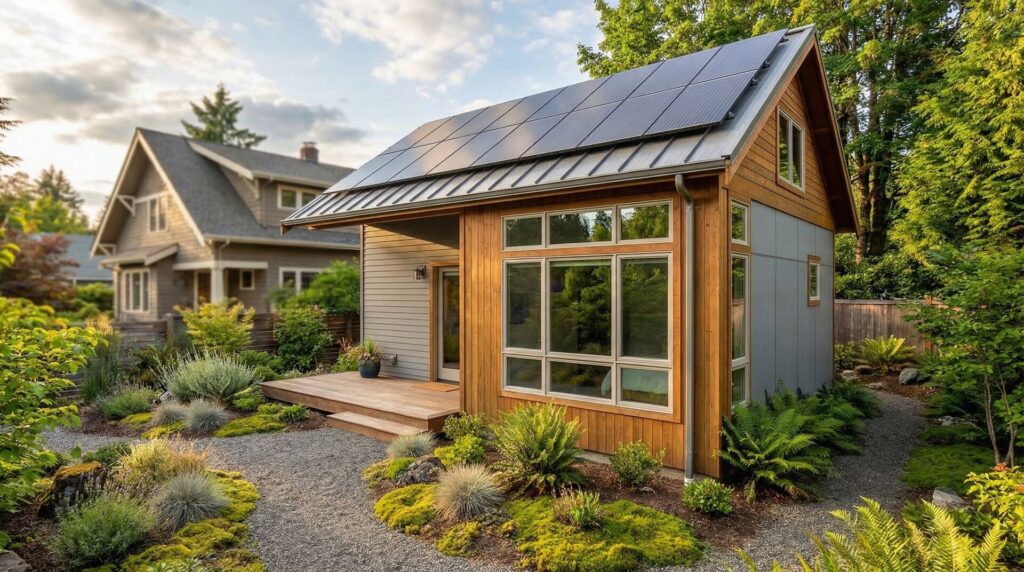
Washington State Energy Code: What Your DADU Must Meet
Washington State has one of the most stringent residential energy codes in the country — and your DADU must comply. The Washington State Energy Code (WSEC) sets minimum requirements for insulation, windows, heating systems, and air sealing that directly affect your DADU’s design, construction cost, and long-term operating expenses.
Meeting code isn’t just a legal requirement — it’s a practical advantage. Energy-efficient DADUs cost less to heat and cool, are more comfortable to live in, and command higher rents from tenants who appreciate lower utility bills.
Insulation Requirements
Proper insulation is the foundation of energy efficiency. Washington State’s requirements for Climate Zone 4C (which covers King County) include:
Wall Insulation
- Minimum: R-21 in 2×6 wall cavities
- Better performance: R-21 cavity + R-5 continuous exterior insulation (reduces thermal bridging through studs)
- Advanced option: R-30+ using exterior rigid insulation systems or high-performance wall assemblies
Ceiling/Attic Insulation
- Minimum: R-49 for standard attics
- Vaulted ceilings: R-38 minimum where ceiling height doesn’t allow full depth
- Blown-in insulation is typically the most cost-effective way to achieve R-49
Floor Insulation
- Crawl space: R-30 between floor joists
- Slab-on-grade: R-10 rigid insulation under and around the perimeter
- Basement walls: R-15 continuous insulation
Foundation Insulation
- Slab perimeter: R-10 to 24 inches below grade
- Crawl space walls (if using wall insulation approach): R-15
Window Performance
Windows are the weakest link in any building envelope. Washington State requires:
- Maximum U-factor: 0.30 (lower is better — measures heat transfer)
- Maximum SHGC: 0.40 (Solar Heat Gain Coefficient — controls solar overheating)
- Window area: Code limits total window area as a percentage of wall area. More windows = more energy loss, but also more natural light.
Practical Window Choices
- Double-pane, low-E: Meets code at the most affordable price point. Standard for most DADU projects.
- Triple-pane: Exceeds code significantly. Higher cost but dramatically better comfort and energy performance. Reduces noise — valuable for DADUs near streets or neighbors.
- Strategic placement: South-facing windows capture free solar heat in winter. North-facing windows provide consistent, glare-free light. Minimize west-facing windows to control summer overheating.
HVAC: Heating and Cooling
The HVAC system choice significantly affects both upfront cost and monthly utility bills.
Mini-Split Heat Pumps: The DADU Standard
- How they work: Electric heat pumps that provide both heating and cooling from a single outdoor unit connected to one or more indoor units.
- Efficiency: 300–400% efficient (every unit of electricity produces 3–4 units of heat). Far more efficient than electric resistance or gas furnaces.
- Cost: $8,000–$15,000 installed for a single-zone system (appropriate for most DADUs)
- Advantages for DADUs: Compact, quiet, no ductwork needed, zone-controlled, and meets code easily
Other Options
- Ducted mini-split: Conceals the indoor unit in the ceiling or wall for a cleaner look. $10,000–$18,000.
- In-floor radiant heat: Excellent comfort, especially with slab-on-grade foundations. $12,000–$20,000. Requires a separate cooling solution.
- Electric resistance (baseboard): Low upfront cost but very high operating cost. Not recommended — and may not meet code efficiency requirements.
Air Sealing
An airtight building envelope is essential for energy efficiency. Washington State requires blower door testing to verify air sealing:
- Maximum air leakage: 5 ACH50 (air changes per hour at 50 pascals of pressure)
- Better target: 3 ACH50 or below provides superior comfort and energy performance
- Key sealing locations: Sill plates, window/door frames, electrical/plumbing penetrations, attic access, and rim joists
- Testing: Blower door test during construction (after air barrier is complete but before drywall in some cases, and again at completion)
Hot Water
Water heating is typically the second-largest energy expense in a small dwelling:
- Heat pump water heater: Most efficient option. 3–4x more efficient than standard electric. $2,500–$4,000 installed. Requires a space with adequate air volume (or ducted to exterior).
- Tankless electric: Compact, on-demand hot water. Good for small DADUs with low hot water demand. $1,500–$3,000 installed.
- Standard electric tank: Lowest upfront cost but highest operating cost. $800–$1,500 installed.
Energy Code Compliance Paths
Washington State offers two paths to demonstrate code compliance:
Prescriptive Path
- Meet each individual code requirement (insulation R-values, window U-factors, etc.)
- Simpler to document
- Less design flexibility
Performance Path
- Use energy modeling to demonstrate the overall building meets or exceeds the code’s energy target
- Allows trade-offs — for example, better windows can offset slightly less insulation
- More design flexibility
- Requires energy modeling software and documentation
Going Beyond Code: Worth the Investment?
Exceeding energy code requirements adds upfront cost but reduces long-term operating expenses:
- Additional insulation (R-30 walls): $2,000–$4,000 additional. Saves $200–$400/year in heating costs.
- Triple-pane windows: $3,000–$6,000 additional. Saves $150–$300/year and significantly improves comfort.
- Solar panels: $8,000–$15,000. Can offset most or all of the DADU’s electricity use. May qualify for federal tax credits.
- Heat pump water heater: $1,000–$2,000 additional over standard. Saves $200–$400/year.
For rental DADUs, energy efficiency is a selling point — tenants increasingly ask about utility costs, and lower bills justify higher rent.
APEX DADU Builds Energy-Smart
Every APEX DADU meets or exceeds Washington State Energy Code requirements. We specify high-performance insulation, quality windows, and efficient heat pump systems as standard — because energy efficiency isn’t a luxury in the Pacific Northwest, it’s a necessity.
Contact APEX DADU to discuss energy-efficient design options

Leave a Reply