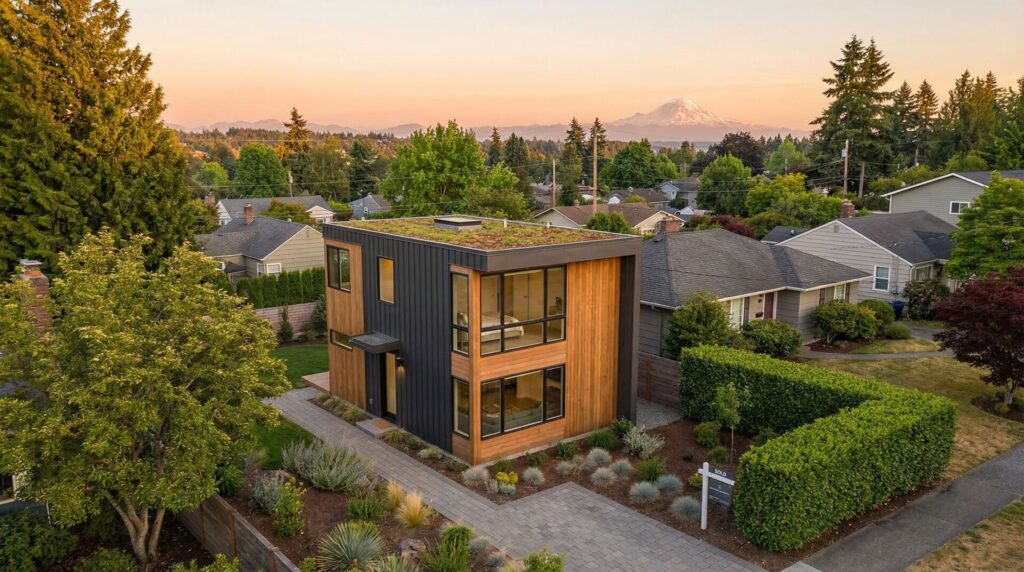
The Investment Case for King County DADUs
At $400,000–$650,000 all-in, a DADU is a major investment. The question every homeowner asks is: Is it worth it? The answer depends on your goals — rental income, property value, family housing, or some combination. But from a pure numbers perspective, King County DADUs consistently produce strong returns when planned well.
This analysis uses real market data from the King County rental and real estate markets to give you a clear picture of the financial case.
Revenue Stream #1: Rental Income
Rental income is the most immediate and measurable return on a DADU investment.
King County DADU Rental Rates (2026)
- Studio/1-bed DADU (400–600 sq ft): $1,500–$2,200/month
- 1-bed DADU (600–800 sq ft): $2,000–$2,800/month
- 2-bed DADU (800–1,000 sq ft): $2,500–$3,500/month
Location Matters
- Seattle neighborhoods: $2,200–$3,500/month — highest rents due to proximity to jobs and transit
- Eastside (Bellevue, Kirkland, Redmond): $2,300–$3,500/month — strong tech employer demand
- South King County (Renton, Auburn, Federal Way): $1,500–$2,500/month — lower rents but also lower construction costs
- Unincorporated King County: $1,500–$2,800/month — varies widely by specific location
For detailed rental projections by area, see our rental income guide.
Annual Rental Income Projections
Using a mid-range 800 sq ft DADU at $2,400/month:
- Gross annual rent: $28,800
- Vacancy allowance (5%): -$1,440
- Maintenance and repairs (5%): -$1,440
- Property management (if used, 8%): -$2,304
- Additional insurance: -$1,200
- Net annual income (self-managed): $24,720
- Net annual income (property managed): $22,416
Revenue Stream #2: Property Value Increase
A legally permitted DADU adds substantial value to your property.
How DADUs Affect Appraisals
- Direct value addition: Appraisers assign value based on the DADU’s size, quality, and rental income potential
- Income approach: For investment properties, appraisers capitalize the rental income stream — a DADU generating $24,000/year at a 5% cap rate adds $480,000 in value
- Comparable sales: As more DADUs are built in King County, comparable sales data increasingly supports higher valuations
Estimated Value Increase
- Conservative estimate: 20% increase in total property value
- Moderate estimate: 25–30% increase
- In high-demand areas: 30–40% increase, particularly when the DADU is income-producing
On a King County home valued at $800,000, a 25% increase means $200,000 in added equity — often approaching or exceeding the DADU’s construction cost. See our property value guide for details.
The ROI Math
Let’s run the numbers on a typical scenario:
Assumptions
- DADU cost: $500,000 (all-in for 800 sq ft)
- Monthly rent: $2,400
- Financing: HELOC at 7% interest
- Property value increase: 25% of $800,000 home = $200,000
- Annual rent growth: 3%
- Annual property appreciation: 4%
Year 1
- Net rental income: $24,720
- Interest expense: $35,000
- Net cash flow: -$10,280 (negative — interest exceeds rent in year 1)
- Property value gain: $200,000 (immediate equity creation)
- Total return including equity: +$189,720
Year 5
- Annual net rental income: ~$28,600 (with 3% annual growth)
- Cumulative net rental income: ~$132,000
- Remaining loan balance: ~$415,000 (assuming interest-only payments)
- Property value gain: $200,000 + additional appreciation
- Cumulative return: well into positive territory
Year 10
- Annual net rental income: ~$33,100
- Cumulative net rental income: ~$293,000
- At this point, rental income alone has covered more than half the construction cost
- Property value continues to appreciate
Break-Even Analysis
How quickly does a DADU pay for itself?
- Cash-flow break-even (rent covers financing): Year 2–4, depending on interest rate and rental income
- Full cost recovery from rental income: 12–18 years at current rates
- Including property appreciation: Often break-even on day one — the DADU adds value approaching its cost immediately
Non-Financial Returns
The ROI calculation doesn’t capture everything a DADU provides:
- Family housing: Keeping aging parents close, housing adult children, or providing space for caregivers has value beyond dollars
- Flexibility: A DADU can serve as a rental today, family housing tomorrow, and a home office next year
- Housing security: Rental income provides a financial buffer — if you lose your primary income, the DADU rent can cover your mortgage
- Retirement asset: A paid-off DADU generating $30,000+/year in rental income is a significant retirement resource
When a DADU May NOT Be Worth It
Honest analysis requires acknowledging when a DADU isn’t the right investment:
- Very low rental market: If your area commands less than $1,500/month, the payback period stretches significantly
- Extreme site costs: Properties with severe slopes, poor access, or major septic issues can push costs to $700,000+, making the math harder
- Short-term ownership: If you plan to sell within 2–3 years, the immediate property value increase may not offset the full investment
- Over-leveraged: If financing the DADU strains your overall financial position, the risk may outweigh the return
Maximizing Your DADU ROI
- Right-size the unit. Build the largest DADU your lot allows — rental income scales with size, but permit and utility costs are similar.
- Design for rentability. In-unit laundry, good storage, private outdoor space, and a functional kitchen command premium rents.
- Location awareness. DADUs near transit, employers, and amenities rent faster and for more.
- Control costs. Work with an experienced builder who knows how to manage construction costs without cutting corners.
- Consider long-term hold. The longer you own the DADU, the better the cumulative return as rents grow and the loan pays down.
APEX DADU Builds for Returns
We design and build DADUs with both livability and ROI in mind. APEX DADU helps you make decisions that maximize your return — from unit size and layout to finish level and rental strategy. Every project gets a custom financial analysis so you understand the investment case for your specific property.
Contact APEX DADU for a free ROI analysis for your property

Leave a Reply