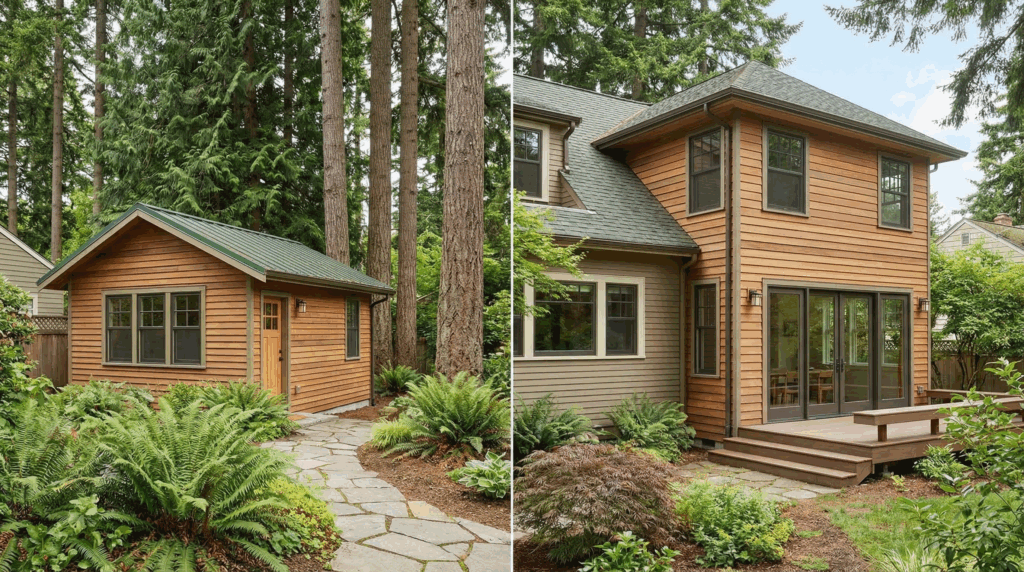
ADU vs. DADU: Understanding the Terminology
If you’ve been researching accessory dwelling units in King County, you’ve probably seen both ADU and DADU used — sometimes interchangeably. Here’s the simple distinction:
- ADU (Accessory Dwelling Unit): The umbrella term for any secondary living unit on a single-family lot. This includes both attached and detached units.
- DADU (Detached Accessory Dwelling Unit): A specific type of ADU that is a freestanding structure, physically separate from the primary home.
- Attached ADU: A secondary unit that shares at least one wall with the primary home — a basement conversion, garage conversion, or addition.
In King County, the regulations, permits, and opportunities differ depending on which type you choose.
Detached ADUs (DADUs): Pros and Cons
Advantages
- Complete privacy: Separate structure means separate living — no shared walls, no noise transfer, no shared entries.
- Higher rental value: Tenants pay a premium for standalone units. A DADU typically rents for 15–25% more than a comparable attached ADU.
- Design freedom: The structure can have its own architectural identity while complementing your home.
- Property value: DADUs generally add more resale value than attached conversions because they appeal to a wider range of buyers.
- No disruption to primary home: Construction happens in the yard, not inside your house.
Disadvantages
- Higher cost: New construction from the ground up costs more than converting existing space.
- Yard impact: You’ll lose some outdoor space to the structure, setbacks, and access paths.
- Utility runs: Running sewer, water, and electrical to a separate structure adds cost.
- Longer timeline: Typically 10–18 months versus 6–12 for an attached conversion.
Attached ADUs: Pros and Cons
Advantages
- Lower cost: Converting a basement, garage, or adding onto your home is typically 30–50% cheaper than new construction.
- Shared utilities: Leveraging existing plumbing, electrical, and HVAC connections saves money.
- Faster completion: Conversions typically take 6–12 months.
- Preserves yard space: No new footprint in your outdoor area.
Disadvantages
- Less privacy: Shared walls mean shared noise, shared entries, or both.
- Lower rental value: Tenants typically pay less for attached units.
- Construction disruption: Work happens inside or directly attached to your living space.
- Design constraints: The existing structure limits what’s possible.
- Ceiling height issues: Basement conversions often struggle with minimum ceiling height requirements.
King County Regulations: How They Differ
King County allows up to two ADUs per lot in these configurations:
- One attached + one detached
- Two attached
- Two detached (in one or two structures)
Key regulatory differences:
- Size limits: Both attached and detached ADUs are capped at 1,000 square feet of heated floor area. However, basement space in a detached ADU doesn’t count toward the maximum.
- Setbacks: Detached ADUs must maintain minimum setbacks (5 feet side/rear in urban areas). Attached ADUs follow the primary home’s setback rules.
- Height: Both must comply with zone height limits, but detached units face more scrutiny for neighbor impact on privacy and views.
- Lot size: Detached ADUs in urban areas require a minimum lot size of 3,200 square feet.
Cost Comparison
Here’s a general comparison for King County in 2026:
- DADU (800 sq ft new construction): $400,000–$650,000
- Attached ADU — basement conversion (800 sq ft): $150,000–$300,000
- Attached ADU — garage conversion (400 sq ft): $100,000–$200,000
- Attached ADU — addition (600 sq ft): $250,000–$450,000
The gap narrows significantly when you factor in the higher rental income and property value increase that DADUs deliver.
Which Is Right for You?
Choose a DADU if:
- You have sufficient yard space and lot size
- Maximum rental income is a priority
- You want complete separation between units
- You’re building for long-term property value
- You don’t want construction inside your home
Choose an attached ADU if:
- You have a suitable basement, garage, or area for an addition
- Budget is the primary constraint
- You want to preserve your outdoor space
- You need a faster timeline
- The unit will house family rather than tenants
Consider both if: Your lot qualifies for two ADUs. Building one of each maximizes your options — one for rental income, one for family, or both for income.
Let Us Help You Decide
The right choice depends on your specific property, goals, and budget. APEX DADU evaluates all the factors — lot size, zoning, existing structures, soil conditions, utilities, and your personal objectives — to recommend the best path forward.
Schedule a free property evaluation and we’ll show you exactly what’s possible.

Leave a Reply