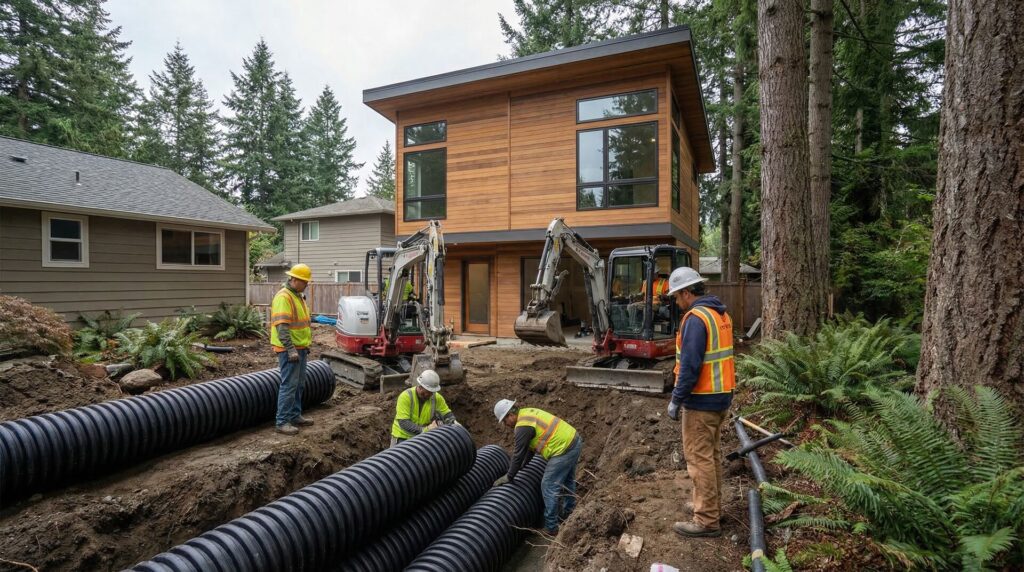
Sewer or Septic: Why It Matters for Your DADU
One of the first questions any King County DADU project must answer is whether your property connects to public sewer or relies on a private septic system. This single factor affects your project timeline, budget, permit requirements, and even the size of the DADU you can build. Getting clarity early prevents surprises later.
Roughly 30% of residential properties in King County are on septic systems — primarily in rural and semi-rural areas of the county. If you’re in an incorporated city like Seattle, Bellevue, or Kirkland, you’re almost certainly on sewer. If you’re in unincorporated King County, it could be either.
How to Determine Your Connection Type
Before moving forward with your DADU project, confirm which system serves your property:
- Check your utility bills: If you pay a sewer bill to King County or a local sewer district, you’re on public sewer.
- King County Parcel Viewer: The online parcel viewer shows sewer service area boundaries.
- Title report: Septic system easements or maintenance agreements appear on your title.
- Look for a cleanout: A sewer cleanout cap in your yard indicates a sewer connection. A septic tank lid or drainfield area suggests septic.
Building a DADU on Public Sewer
Properties connected to public sewer have a more straightforward path to adding a DADU. Here’s what to expect:
Sewer Connection Process
- Side sewer extension: Your DADU connects to the existing side sewer line running from your primary home to the public main. A new branch line is typically trenched from the DADU to the existing line.
- Capacity confirmation: The local sewer district confirms the main has capacity for the additional connection.
- Permit requirement: A separate side sewer permit may be required in addition to your building permit.
Sewer Connection Costs
- Connection fees: $5,000–$15,000 depending on the sewer district
- Trenching and piping: $3,000–$8,000 depending on distance and depth
- Inspection fees: $500–$1,500
Total sewer costs for a DADU typically run $8,500–$24,500. This is generally included in the utility connection line item of your overall DADU cost estimate.
Building a DADU on Septic
Septic properties face additional requirements, but building a DADU is still very possible. The process requires more upfront evaluation.
Septic System Evaluation
Before King County will approve a DADU on a septic property, the existing system must be evaluated:
- System inspection: A licensed inspector examines the tank, distribution box, and drainfield for condition and remaining capacity.
- Design capacity check: The original septic design specifies a number of bedrooms. Adding a DADU increases the bedroom count, which may exceed the system’s design capacity.
- Soil evaluation: If upgrades are needed, a soil evaluation determines what type of replacement or expansion system is appropriate.
Common Septic Scenarios
- Existing system has capacity: If your septic was designed for more bedrooms than your primary home uses, the DADU may connect without modification. This is the best-case scenario.
- System upgrade required: If adding the DADU exceeds system capacity, you’ll need to upgrade — either expanding the drainfield or installing a new system.
- System replacement needed: If the existing system is failing or at end of life, a complete replacement is required before the DADU permit will be issued.
Septic Costs for DADU Projects
- System inspection: $500–$1,000
- Design and engineering: $3,000–$6,000
- Minor upgrades (capacity available): $5,000–$10,000
- Drainfield expansion: $15,000–$30,000
- Full system replacement: $25,000–$50,000+
Septic costs can significantly impact your total DADU budget. It’s essential to get the septic evaluation done early so you know what you’re dealing with.
King County Septic Regulations for DADUs
King County Environmental Health oversees septic systems. Key regulations affecting DADU projects include:
- Operating permit: All septic systems in King County must have a current operating permit.
- Bedroom count matters: Septic capacity is calculated based on number of bedrooms, not number of people. Each bedroom in your DADU increases the required capacity.
- Reserve drainfield area: King County requires a designated reserve area for future drainfield replacement. Your DADU cannot be built on this reserve area.
- Setbacks from septic: DADUs must maintain minimum distances from septic tanks, drainfields, and reserve areas — typically 10 feet from tanks and drainfields.
Sewer vs. Septic: Impact on Your DADU Project
- Timeline: Sewer connections add 2–4 weeks. Septic evaluations and potential upgrades can add 2–6 months.
- Cost: Sewer connections typically cost $8,500–$24,500. Septic can range from $5,000 (no upgrades needed) to $50,000+ (full replacement).
- DADU placement: Septic properties have more constraints on where the DADU can be located due to tank, drainfield, and reserve area setbacks.
- DADU size: On septic properties, the DADU size may be limited by system capacity, particularly the number of bedrooms.
Can You Connect to Sewer Instead of Using Septic?
If your property is within a sewer service area but currently on septic, you may be able to connect to public sewer. This involves:
- Confirming sewer availability with the local district
- Paying connection and capacity charges ($10,000–$30,000+)
- Installing a new side sewer line to the public main
- Decommissioning the existing septic system
While expensive, connecting to sewer can simplify the DADU project and eliminate ongoing septic maintenance. It may also make sense if your septic system needs replacement anyway.
APEX DADU Handles the Utility Details
Whether your property is on sewer or septic, APEX DADU manages the entire utility connection process — from initial evaluation through permitting and installation. We’ve built DADUs on both systems across King County and know how to keep costs reasonable and timelines on track.
Contact APEX DADU for a free property evaluation — we’ll assess your sewer or septic situation and give you a clear picture of what your DADU project will require.

Leave a Reply