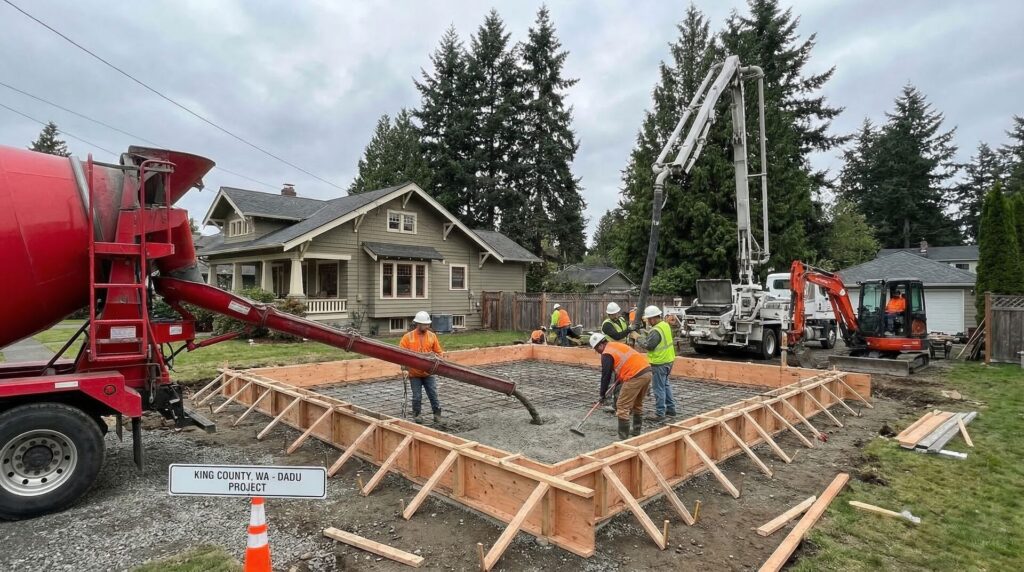
Your Foundation Choice Shapes the Entire Project
The foundation is literally what your DADU is built on — and in King County, your lot’s topography, soil conditions, and drainage patterns determine which foundation type makes sense. The cost difference between options can be $15,000–$35,000, making this one of the most impactful decisions in your project budget.
Option 1: Slab-on-Grade
A concrete slab poured directly on prepared ground. The simplest and most affordable foundation option.
How It Works
- Site is excavated and graded to a level surface
- Gravel base is compacted for drainage
- Vapor barrier is installed
- Rigid insulation is placed (required for energy code compliance)
- Rebar and mesh are positioned
- Concrete is poured in a single operation (typically 4–6 inches thick with thickened edges)
Cost: $20,000–$28,000
Advantages
- Lowest cost foundation option
- Fastest to construct (1–2 weeks)
- No crawl space to maintain or deal with moisture issues
- In-floor radiant heating is easy to incorporate
- Level entry — excellent for accessibility
Disadvantages
- Plumbing is set in concrete — repairs are more difficult and expensive
- No access to mechanical systems under the floor
- Not suitable for sloped sites without extensive grading
- If soil conditions are poor, additional preparation is needed
Best For
- Flat lots with stable soil
- Budget-conscious projects
- Accessibility-focused designs
- Projects where speed matters
Option 2: Crawl Space
A raised foundation with 18–36 inches of accessible space beneath the DADU floor.
How It Works
- Concrete footings poured around the perimeter and at interior bearing points
- Stem walls built on the footings (concrete block or poured concrete)
- Floor joists span between the walls
- Subfloor (plywood) is installed on the joists
- Crawl space includes moisture barrier, ventilation, and insulation
Cost: $25,000–$35,000
Advantages
- Access to plumbing, electrical, and HVAC systems for future maintenance or repair
- Better suited for sites with moderate slope — stem walls can step down with the grade
- Elevates the living space above potential water intrusion
- Wood-framed floor feels warmer underfoot than concrete slab
Disadvantages
- $5,000–$10,000 more than slab-on-grade
- Crawl space requires ongoing moisture management (vapor barrier, ventilation, or encapsulation)
- Step up to entry level — not ideal for accessibility without a ramp
- More construction time than slab (2–3 weeks)
Best For
- Moderately sloped sites
- Areas with high water table or drainage concerns
- Projects where future mechanical access is valued
- Lots where the DADU is significantly far from the main house (long utility runs benefit from crawl space access)
Option 3: Basement or Daylight Basement
A full or partial basement adds significant usable space below the DADU’s main level.
How It Works
- Full excavation to 8–9 feet below grade
- Concrete footings and foundation walls
- Waterproofing on exterior walls
- Drainage system around the perimeter
- Floor slab poured inside the foundation walls
- First-floor framing on top of the foundation
Cost: $35,000–$55,000
Advantages
- Additional usable space — basement square footage in a detached ADU does not count toward the 1,000 sq ft maximum in King County
- Storage, laundry, and mechanical equipment space without using precious floor area
- Daylight basements on sloped lots can have windows and feel like a finished lower level
- Significantly increases the functional value of the DADU
Disadvantages
- $15,000–$30,000 more than slab-on-grade
- Extensive excavation required — longer construction time (3–5 weeks for foundation alone)
- Waterproofing is critical in King County’s wet climate — any failure creates significant problems
- Not feasible on sites with high water table or poor drainage
Best For
- Sloped lots where excavation naturally exposes one or more walls (daylight basement)
- Projects that need maximum usable space
- Lots where the 1,000 sq ft limit feels restrictive — unheated basement space doesn’t count
- Homeowners who want laundry, storage, and mechanical systems out of sight
Soil Conditions and Foundation Choice
King County has varied soil conditions that directly affect foundation decisions:
- Glacial till: Dense, stable soil found across much of King County. Supports any foundation type well.
- Sandy soil: Good drainage but may require wider footings. Works well for all foundation types.
- Clay soil: Expands when wet, contracts when dry. May require engineered footings or deeper foundations.
- Fill soil: Previously filled areas need careful evaluation. May require compaction or engineered solutions.
- High water table: Eliminates basements. Slab-on-grade with proper drainage is typically best.
A geotechnical report ($1,500–$3,000) identifies your soil conditions and recommends the appropriate foundation approach.
Energy Code and Foundation Insulation
Washington State’s energy code requires foundation insulation regardless of type:
- Slab: Rigid insulation under and around the slab perimeter
- Crawl space: Insulation between floor joists or on crawl space walls
- Basement: Interior or exterior wall insulation
Foundation insulation typically adds $2,000–$5,000 to the project. It’s not optional — it’s required by code and significantly impacts the DADU’s energy performance.
APEX DADU Recommends the Right Foundation
We evaluate your site conditions, slope, soil, and drainage before recommending a foundation type. APEX DADU designs foundations that are structurally sound, code-compliant, and cost-appropriate for your specific lot — not a one-size-fits-all approach.
Contact APEX DADU for a site evaluation and foundation recommendation

Leave a Reply