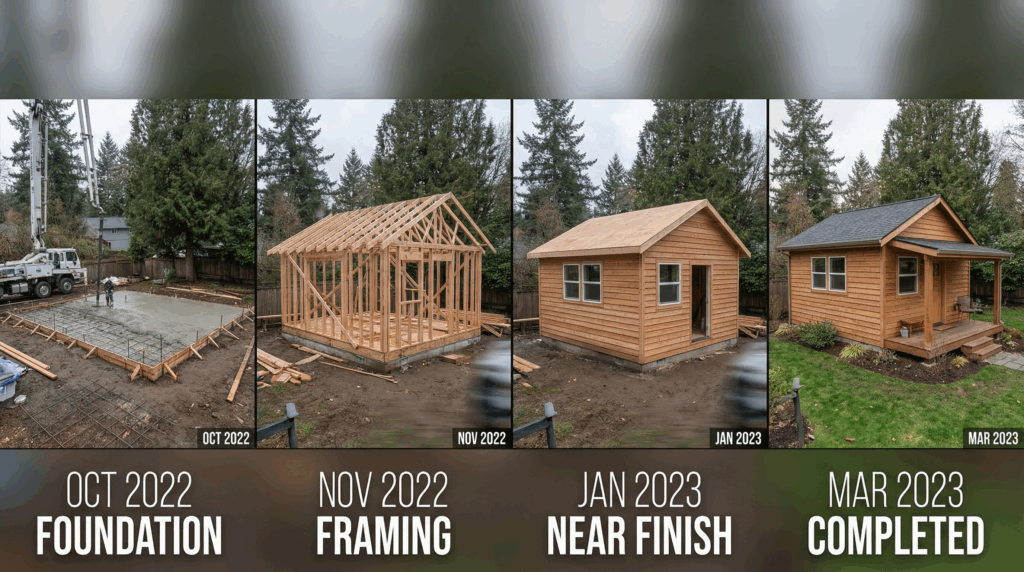
The Timeline: What to Expect
Building a DADU in King County typically takes 10–18 months from your first phone call to move-in day. That timeline breaks down roughly as:
- Feasibility and design: 1–3 months
- Permitting: 2–6 months
- Construction: 4–8 months
- Final inspections and occupancy: 2–4 weeks
Every project is different. Simple builds on flat lots with sewer access move faster. Complex sites with slopes, septic, or design challenges take longer. Here’s what happens at each stage.
Phase 1: Feasibility Assessment (Weeks 1–2)
Before spending money on design, you need to know if a DADU is actually feasible on your property. A thorough feasibility assessment covers:
Lot Evaluation
- Lot size: Does your lot meet the minimum (3,200 sq ft in urban King County)?
- Zoning: Is your zone eligible for a detached ADU?
- Setbacks: After applying setback requirements, is there enough buildable area for the DADU you want?
- Easements: Are there utility, access, or drainage easements that restrict building?
- Critical areas: Are there wetlands, steep slopes, or other environmental constraints?
Utility Access
- Sewer or septic: Properties on sewer have a simpler path. Septic properties need system evaluation and potentially upgrades.
- Water: Can a new water line be run to the DADU location?
- Electrical: Is there capacity for a new service panel, or does the main panel need upgrading?
Site Conditions
- Topography: Flat lots are straightforward. Slopes add cost but can enable daylight basements.
- Soil conditions: May require a geotechnical report.
- Trees: Significant trees near the build site trigger protection requirements.
- Access: Can construction equipment reach the build site?
At APEX DADU, we do this assessment at no cost. It’s the foundation of a successful project.
Phase 2: Design (Weeks 3–12)
Once feasibility is confirmed, design begins. This phase produces the complete set of drawings and documents needed for permitting.
Schematic Design
- Establish the DADU’s size, layout, and position on the lot
- Define the program — bedrooms, bathrooms, kitchen, living space, storage
- Choose single-story vs. two-story
- Select a general style and aesthetic direction
Design Development
- Refine the floor plan with exact dimensions
- Select exterior materials and finishes
- Design the kitchen and bathroom layouts
- Plan mechanical systems (HVAC, plumbing, electrical)
- Address energy code compliance
Construction Documents
- Complete architectural drawings (floor plans, elevations, sections, details)
- Structural engineering calculations
- Site plan with setbacks, utilities, and drainage
- Energy compliance documentation
- Any required reports (geotechnical, drainage, tree protection)
This package is what gets submitted for permits. Its quality directly determines how quickly your permit is approved. Explore design options in our floor plan guide.
Phase 3: Permitting (Months 3–8)
The permit phase is where most projects experience the longest wait. Here’s what happens:
- Application submission: Complete documents submitted through MyBuildingPermit (for unincorporated King County) or the relevant city portal.
- Intake review (1–2 weeks): Staff verifies the application is complete.
- Plan review (6–16 weeks): Building, zoning, fire, and health department reviewers examine your plans.
- Correction response (2–4 weeks per round): Most applications receive correction requests. Quick, complete responses keep things moving.
- Permit issuance: Once all reviews pass, the permit is issued.
The key to fast permitting is a complete, accurate application. Our permit guide covers this in detail.
Phase 4: Pre-Construction (Weeks 1–2 After Permit)
With permit in hand, preparation begins:
- Construction schedule: Your builder creates a detailed timeline with milestones.
- Material ordering: Long-lead items (windows, cabinets, fixtures) are ordered early to prevent delays.
- Subcontractor scheduling: Trades are scheduled in sequence — excavation, foundation, framing, mechanical, finishes.
- Site preparation: Tree protection fencing, construction access, temporary utilities, and erosion control.
Phase 5: Construction (Months 4–12)
Construction follows a standard sequence. Here’s what you’ll see happening:
Foundation (Weeks 1–3)
- Excavation and grading
- Formwork and rebar
- Concrete pour
- Foundation inspection
Framing (Weeks 3–6)
- Floor framing (if raised foundation)
- Wall framing
- Roof framing and sheathing
- Window and exterior door installation
- Framing inspection
Mechanical Rough-In (Weeks 6–9)
- Plumbing rough-in
- Electrical rough-in
- HVAC installation
- Insulation
- Mechanical inspections
Exterior (Weeks 7–11)
- Siding installation
- Roofing
- Exterior paint or stain
- Gutters and downspouts
Interior Finishes (Weeks 9–14)
- Drywall
- Interior paint
- Flooring
- Cabinetry and countertops
- Fixtures and hardware
- Appliance installation
Final Site Work (Weeks 13–16)
- Utility connections finalized
- Driveway or path paving
- Landscaping restoration
- Final grading and drainage
Phase 6: Inspections and Occupancy (Weeks 1–3 After Construction)
The final stretch:
- Final inspections: Building, electrical, plumbing, mechanical, and fire inspections.
- Punch list: Any minor items identified during inspection are corrected.
- Certificate of occupancy: Once all inspections pass, the county issues a certificate of occupancy — your DADU is officially ready for use.
- Utility activation: Permanent utility services activated.
- Move-in or tenant placement: Your DADU is ready for its first occupant.
What Can Go Wrong (And How to Prevent It)
- Permit delays: Prevention — submit complete, accurate applications. Work with a builder who knows what reviewers look for.
- Weather delays: Prevention — schedule foundation and framing during drier months when possible. Budget extra time for winter projects.
- Material delays: Prevention — order long-lead items early. Have backup selections identified.
- Budget overruns: Prevention — detailed budget with contingency (5–10%). Make finish selections before construction starts.
- Neighbor concerns: Prevention — communicate early. Let neighbors know what’s happening and when. Address legitimate concerns proactively.
Ready to Start Your DADU Journey?
Building a DADU is a significant project, but with the right team it’s a straightforward process with a clear path from start to finish. APEX DADU manages every phase — feasibility, design, permitting, construction, and final occupancy — so you get a finished DADU without the project management headaches.
Contact APEX DADU to start your free feasibility assessment

Leave a Reply