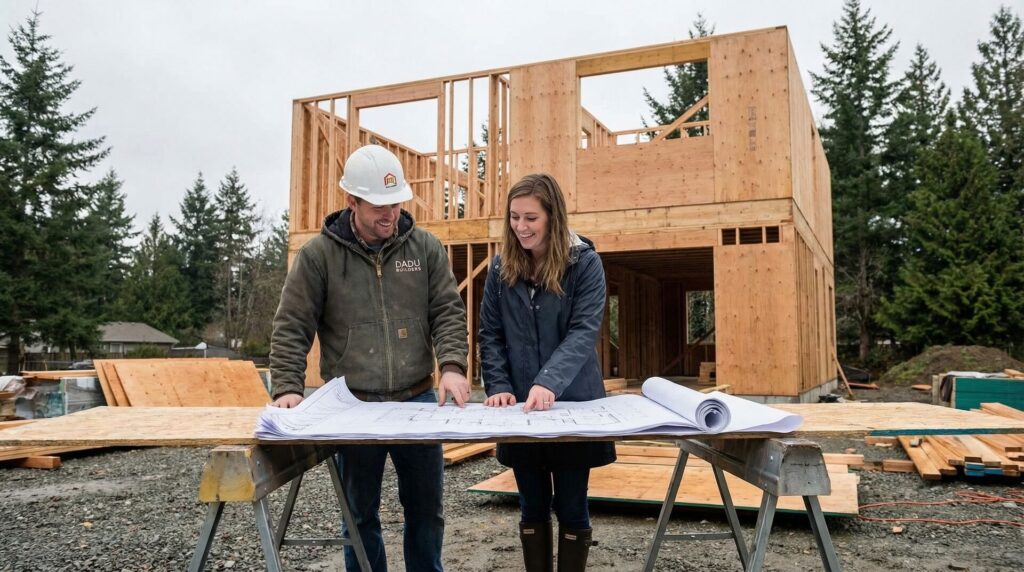
Why Your Builder Choice Matters More for DADUs
Building a DADU isn’t the same as a kitchen remodel or a deck addition. It’s a complete building project — with its own foundation, mechanical systems, utility connections, and permitting requirements. In King County, the permitting complexity alone makes builder experience a critical factor. The right builder navigates permits efficiently, manages costs accurately, and delivers a finished product that meets code and your expectations.
The wrong builder can mean months of permit delays, budget overruns, and a DADU that doesn’t perform as designed. Here’s how to find the right one.
Essential Qualifications
Licensing and Insurance
- Washington State contractor license: Verify at the Department of Labor & Industries website. Active, current, and in good standing.
- General liability insurance: Minimum $1 million. Protects you if something goes wrong during construction.
- Workers’ compensation: Required in Washington State for all employees. Protects you from liability if a worker is injured on your property.
- Bonding: Washington State requires contractors to be bonded. The bond protects homeowners against contractor non-performance.
Specific DADU Experience
- Number of completed DADUs: Look for builders with at least 5–10 completed DADU projects in King County.
- King County permit experience: A builder who’s navigated King County’s specific permitting process knows what reviewers expect.
- Portfolio: Ask to see completed projects — ideally in person. Photos help, but walking through a finished DADU is better.
- Reference contacts: Talk to previous DADU clients. Ask about timeline accuracy, budget adherence, communication, and quality.
Questions to Ask Every Builder
- How many DADUs have you built in King County? Specifics matter — “lots of ADUs” isn’t the same as documented King County DADU experience.
- What’s your average permit timeline? Experienced builders should be able to cite realistic numbers and explain how they keep permits moving.
- Do you handle design and permitting, or just construction? Full-service builders manage the entire process. Construction-only builders require you to coordinate design and permits separately.
- How do you handle cost changes? Understand the change order process. How are unexpected costs communicated and approved?
- What’s your payment schedule? Legitimate builders use milestone-based payments tied to completed work — not large upfront deposits.
- Who is my point of contact? Will you communicate directly with the project manager or builder? How often will you receive updates?
- What warranty do you provide? Washington State requires a minimum warranty. Many quality builders offer additional coverage.
Red Flags to Watch For
- No DADU-specific experience: General contractors who “can figure it out” cost you time and money during their learning curve.
- Large upfront payment requests: More than 10–15% upfront is a red flag. Payments should track with completed work.
- No written contract: Every project needs a detailed written contract specifying scope, timeline, payment schedule, and change order process.
- Significantly lower bids: If one bid is 30%+ below others, something is missing from their scope — or they plan to make it up in change orders.
- No references: A quality builder has satisfied clients willing to vouch for their work.
- Pressure to sign quickly: Reputable builders give you time to review proposals and make informed decisions.
- No permit experience: If they want you to handle permits, they may not understand the King County process.
Full-Service vs. Construction-Only Builders
Full-Service Builders
- Handle everything from design through move-in
- Single point of accountability
- Coordinate between architects, engineers, and trades
- Manage permitting from start to finish
- Higher overall fee but less homeowner effort
Construction-Only Builders
- Build from plans you provide
- You’re responsible for design, engineering, and permitting
- Lower builder fee, but you manage more of the process
- Can work well if you have a separate architect managing design and permits
Understanding Bids and Proposals
When comparing builders, make sure you’re comparing equivalent scopes:
- Fixed-price vs. cost-plus: Fixed-price contracts give you cost certainty. Cost-plus contracts (cost + builder’s percentage) give flexibility but less predictability.
- What’s included: Does the bid cover permits, utility connections, landscaping restoration, and contingency? Or just construction?
- Allowances: Bids with “allowances” for finishes mean the final cost depends on your selections. Ask what the allowances cover and what typical upgrades cost.
- Timeline: A bid should include an estimated construction timeline with milestones.
The Value of Local Knowledge
A King County DADU builder needs more than construction skills. Local knowledge that matters:
- Familiarity with specific jurisdiction requirements (unincorporated county vs. city rules)
- Relationships with local inspectors and reviewers
- Knowledge of local soil conditions, weather patterns, and site challenges
- Network of reliable local subcontractors
- Understanding of King County’s specific permitting pitfalls
Why Choose APEX DADU
APEX DADU is a full-service DADU builder focused exclusively on King County. We handle every phase — feasibility, design, permitting, construction, and final move-in. Our focus on DADUs means we’ve developed systems and relationships that keep projects on time and on budget. We provide transparent, detailed proposals with no hidden costs.
Contact APEX DADU for a free consultation and project proposal

Leave a Reply