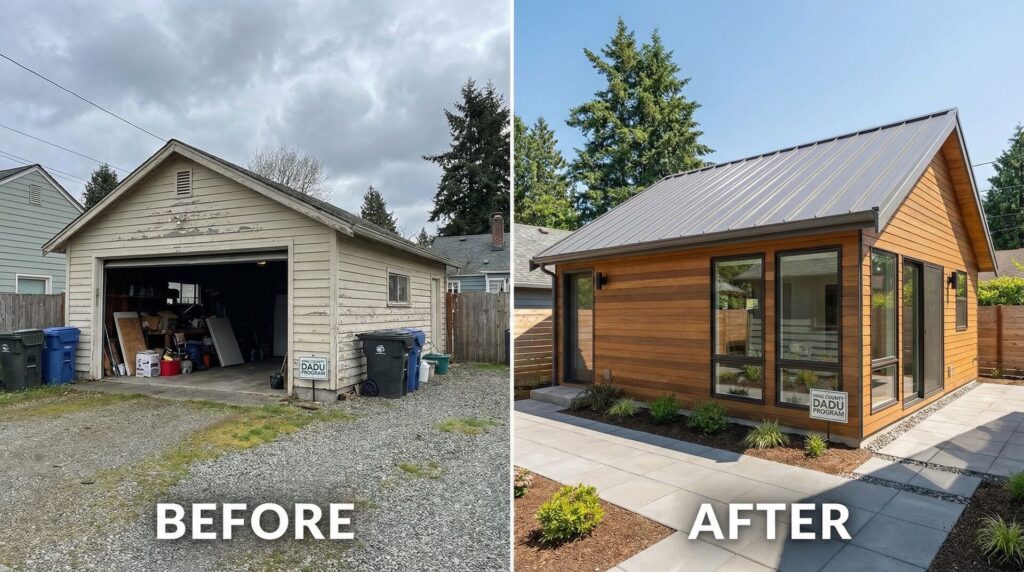
Two Paths to a DADU
If you have a detached garage, you might wonder: should I convert it into a DADU, or tear it down and build new? Both approaches can result in a livable, code-compliant DADU — but they differ significantly in cost, timeline, design flexibility, and final quality. Understanding the trade-offs helps you make the right choice for your property.
Garage Conversion: The Basics
A garage conversion transforms an existing detached garage into a living space by adding insulation, utilities, windows, a kitchen, a bathroom, and interior finishes.
What’s Involved
- Structural evaluation: Verify the existing structure meets residential building code standards
- Foundation upgrade: Garage slabs are typically thinner than residential requirements and may need reinforcement
- Insulation: Walls, ceiling, and floor must meet Washington State Energy Code requirements
- Utility installation: Plumbing (kitchen, bathroom, hot water), electrical (new circuits, panel), and HVAC
- Window and door additions: Garages typically have minimal windows — living space requires natural light and egress windows
- Interior buildout: Drywall, flooring, kitchen, bathroom, finishes
- Exterior modifications: Replacing garage door with a wall, adding siding to match
Conversion Costs: $150,000–$350,000
- Structural and foundation work: $15,000–$40,000
- Insulation and envelope: $10,000–$25,000
- Plumbing: $15,000–$30,000
- Electrical: $8,000–$18,000
- HVAC: $8,000–$15,000
- Kitchen and bathroom: $20,000–$45,000
- Interior finishes: $15,000–$35,000
- Exterior modifications: $10,000–$25,000
- Permits and fees: $30,000–$65,000
- Design and engineering: $8,000–$20,000
Timeline: 6–12 Months Total
- Design and permitting: 3–6 months
- Construction: 3–6 months
New DADU Construction: The Basics
New construction means demolishing the existing garage (if it’s in the way) and building a purpose-designed DADU from the ground up.
New Construction Costs: $400,000–$650,000
This is the all-in cost for a typical 800 sq ft DADU as detailed in our cost guide.
Timeline: 10–18 Months Total
- Design and permitting: 3–8 months
- Demolition (if needed): 1–2 weeks
- Construction: 4–8 months
Head-to-Head Comparison
Cost
- Conversion advantage: $100,000–$300,000 cheaper than new construction in most cases
- But: Conversions of older or poorly-built garages can escalate toward new construction costs once structural, foundation, and code upgrades are factored in
- Hidden conversion costs: Unexpected structural issues, foundation problems, or asbestos/lead paint in older garages can add $20,000–$50,000
Design Flexibility
- New construction wins: You design the exact layout, size, and features you want — optimized for livability
- Conversions are constrained: You’re working within the existing footprint, ceiling height, and structural grid. Many garages are only 400–500 sq ft with 8-foot ceilings — tight for a complete living unit.
Quality and Performance
- New construction wins: Every system is new, purpose-built, and warranted. Insulation, air sealing, and energy performance are optimized from the start.
- Conversions vary: Even with upgrades, a converted garage may not match the comfort, efficiency, or durability of a purpose-built structure. Old framing, thin slabs, and limited ceiling height affect long-term livability.
Timeline
- Conversions are faster: 2–4 months less construction time because the structure already exists
- Permitting: Similar timeline — a conversion still requires full plan review in King County
Long-Term Value
- New construction wins: Purpose-built DADUs appraise higher and command higher rents
- Conversions: May appraise lower if the building’s garage origins are apparent or if finishes compromise
When Conversion Makes Sense
- The garage is well-built with adequate ceiling height (9+ feet), good foundation, and sound structure
- Budget is a primary constraint and the $100K+ savings matters
- The garage location, size, and orientation work well for living space
- You want a faster project with less site disruption
- The garage is relatively new (built in the last 20–30 years) with modern materials
When New Construction Makes Sense
- The existing garage is old, poorly built, or too small for a functional DADU
- You want maximum design flexibility and the best possible living space
- Long-term value and rental income are priorities
- The garage location isn’t ideal for a DADU (too close to property lines, poor orientation)
- Foundation or structural upgrades would cost so much that new construction is comparable
- You want to build larger than the existing garage footprint allows
King County Code Considerations
Whether converting or building new, King County requires:
- Full building permit with plan review
- Compliance with current building code (not the code when the garage was built)
- Washington State Energy Code compliance
- Setback compliance — an existing garage that’s too close to property lines may be nonconforming
- Notice on title recording
- All standard DADU permit requirements
APEX DADU Evaluates Both Options
We’ll assess your existing garage and give you an honest comparison: can it be efficiently converted, or does new construction deliver a better result? APEX DADU helps you choose the approach that maximizes your investment for your specific property and goals.
Contact APEX DADU for a garage evaluation and DADU options analysis

Leave a Reply