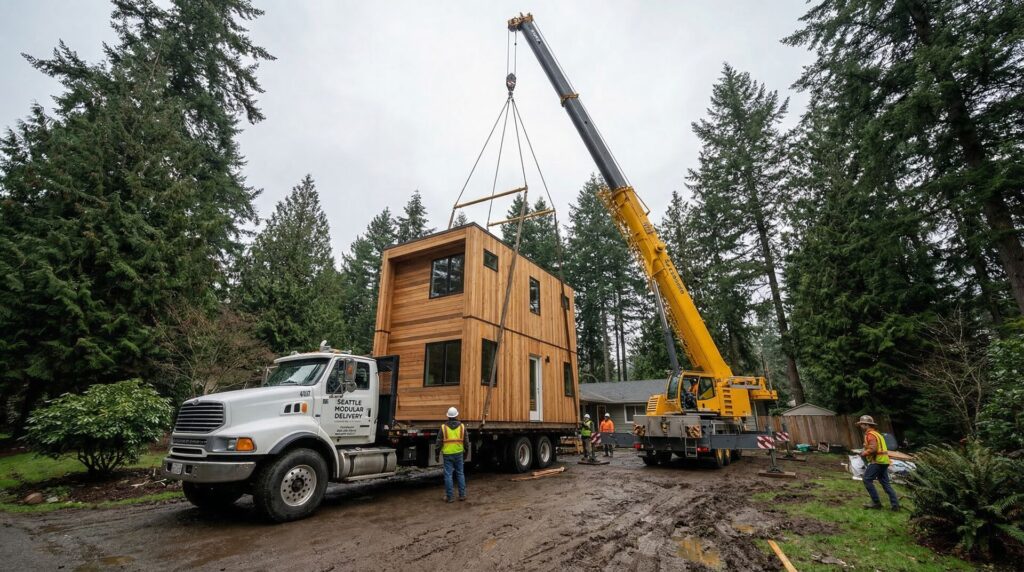
The Prefab Promise: Lower Cost, Faster Build
Prefab DADUs are marketed as a faster, cheaper alternative to traditional site-built construction. The pitch is appealing: factory-built efficiency, predictable pricing, and compressed timelines. In some cases, prefab delivers on this promise. In others — particularly in King County — the reality is more nuanced than the marketing suggests.
This guide compares prefab and site-built DADU costs honestly, including the hidden expenses that change the math for King County homeowners.
What “Prefab” Actually Means
Prefab covers a range of construction methods. Understanding the differences helps you compare apples to apples:
Modular DADUs
- Built in a factory as complete or semi-complete modules
- Transported to your site on a truck
- Crane-set onto a prepared foundation
- On-site finishing work (utility connections, siding, roofing details, interior touch-up)
- Quality control in a factory environment
Panelized DADUs
- Wall panels, floor panels, and roof panels fabricated off-site
- Assembled on-site like a building kit
- All mechanical, electrical, and plumbing installed on-site
- Faster framing but similar finish timeline to site-built
Container or Kit DADUs
- Pre-designed units based on shipping containers or proprietary systems
- Varying degrees of factory completion
- Often marketed as the most affordable option
- May face additional permitting scrutiny in King County
Advertised Prefab Costs vs. Reality
Prefab DADU companies typically advertise prices in the $150,000–$300,000 range for the unit itself. This is the factory-built structure — and it’s only part of the total cost.
What the Advertised Price Usually Includes
- The manufactured structure (walls, roof, floors, windows, doors)
- Basic interior finishes (drywall, flooring, paint)
- Kitchen and bathroom fixtures
- Electrical and plumbing rough-in within the unit
What the Advertised Price Usually Excludes
- Site preparation: $10,000–$25,000
- Foundation: $20,000–$40,000
- Delivery and crane placement: $5,000–$15,000
- Utility connections: $15,000–$35,000 (sewer/septic, water, electrical from street/house to DADU)
- Permits and fees: $43,000–$81,000
- Design and engineering: $10,000–$25,000 (site-specific work still required)
- On-site finishing: $10,000–$30,000 (siding completion, roofing details, trim, touch-up)
- Landscaping restoration: $5,000–$15,000
True Total Cost of a Prefab DADU in King County
When you add the excluded costs to the base unit price:
- Advertised unit price: $150,000–$300,000
- Site, foundation, utilities, permits, finishing: $118,000–$266,000
- Realistic all-in total: $268,000–$566,000
For an apples-to-apples comparison, a site-built DADU of similar size and quality runs $400,000–$650,000 all-in. The gap is narrower than the marketing suggests.
Where Prefab Saves Money
Prefab construction does offer genuine cost advantages in certain areas:
- Labor efficiency: Factory assembly is faster and uses fewer labor hours than on-site construction. This can save 10–20% on labor costs.
- Material waste: Factories buy in bulk and cut with precision, reducing material waste by 15–25%.
- Weather independence: Factory construction isn’t delayed by Pacific Northwest rain — a real advantage for timeline and cost predictability.
- Predictable pricing: Factory quotes are generally firm. On-site construction faces more variables.
Where Prefab Doesn’t Save Money
Several cost categories are identical regardless of construction method:
- Permits and fees: King County doesn’t charge less for prefab DADUs. Permit costs are the same.
- Foundation: Your DADU still needs a code-compliant foundation. Modular units may require a more precise foundation, which can cost more.
- Utility connections: Running sewer, water, and electrical to the DADU costs the same whether the structure is prefab or site-built.
- Site preparation: Grading, drainage, and access requirements are identical.
- Permitting timeline: Plan review takes the same amount of time for prefab and site-built DADUs in King County.
Prefab Challenges in King County
King County’s specific conditions create some unique challenges for prefab DADUs:
Access and Delivery
- Modular units must be transported by truck and placed by crane
- Many King County neighborhoods have narrow streets, mature trees, and overhead power lines that complicate delivery
- If a crane can’t reach your backyard, modular delivery may not be feasible
- Access assessment is essential before committing to a modular approach
Site-Specific Design
- Prefab designs are standardized — they may not optimize for your specific lot’s setbacks, slopes, or views
- Modifications to standard designs often cost as much as custom site-built design
- Small lots with tight setbacks may not accommodate standard prefab dimensions
Local Code Compliance
- King County requires site-specific engineering regardless of construction method
- Structural connections between the factory-built unit and the foundation must be engineered and inspected
- Energy code compliance documentation is still required
Timeline Comparison
- Prefab total timeline: 8–14 months (design: 1–2 months, permits: 3–6 months, factory production: 6–10 weeks, site work and installation: 4–8 weeks)
- Site-built total timeline: 10–18 months (design: 2–3 months, permits: 3–6 months, construction: 4–8 months)
Prefab can save 2–4 months on construction because factory production overlaps with permitting. However, the total timeline difference is modest because permitting is the longest phase regardless of construction method.
When Prefab Makes Sense
- Good site access for truck delivery and crane placement
- Standard lot dimensions that match available prefab designs
- Budget is a primary concern and you’re comfortable with standard finishes
- Timeline savings of 2–4 months matter to you
When Site-Built Makes Sense
- Tight lots where a custom design maximizes every square foot
- Difficult access that prevents truck or crane delivery
- Sloped sites requiring a custom foundation approach
- You want specific finishes, layouts, or design elements
- You want the DADU to architecturally match your primary home
APEX DADU Builds Both Ways
APEX DADU evaluates every project on its merits — we’ll recommend prefab when it makes sense for your lot and budget, and site-built when it doesn’t. Our goal is the best outcome for your property, not a one-size-fits-all approach.
Contact APEX DADU for an honest cost comparison for your property

Leave a Reply