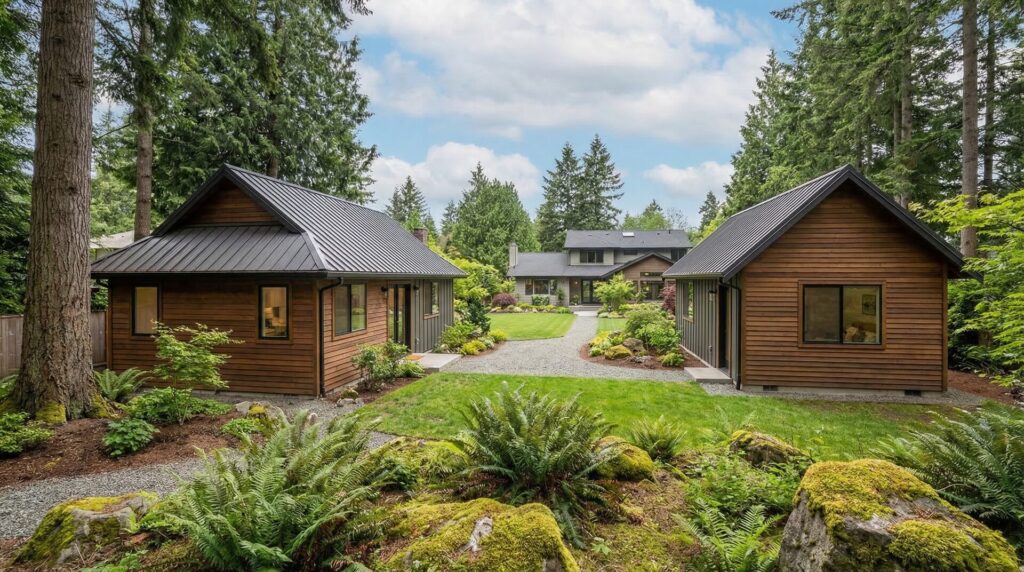
Two ADUs Per Lot: What the Law Says
Under Washington State’s HB 1337, King County and most jurisdictions in Washington must allow at least two accessory dwelling units on any single-family residential lot. This is a significant expansion from previous rules that limited properties to just one ADU — and it opens up new possibilities for rental income, multigenerational housing, and property investment.
The law took effect in phases between 2024 and 2025, and King County’s code now reflects these requirements. Here’s what you need to know about building two ADUs on your property.
Allowed Configurations
King County allows three configurations for two ADUs on a single lot:
Option 1: One Attached + One Detached
- The attached ADU is built within or added onto the primary home (basement conversion, addition, or internal conversion)
- The detached ADU (DADU) is a separate structure in the yard
- This is the most common two-ADU configuration because many homes already have a basement or space that can be converted
Option 2: Two Detached ADUs
- Both ADUs are separate structures on the lot
- Each must comply with setback, size, and height requirements independently
- Requires enough buildable area to place two structures plus the primary home while meeting all setbacks and lot coverage limits
- Best suited for larger lots (7,000+ square feet in most cases)
Option 3: Two Attached ADUs
- Both ADUs are built within or added onto the primary home
- Common in larger homes with both a basement and an upper-floor unit
- Does not affect yard space at all
- Limited by the primary home’s size and layout
Size and Setback Rules for Two ADUs
Each ADU on the lot must independently comply with King County’s size and setback requirements:
- Maximum size: Each ADU can be up to 1,000 square feet of heated floor area
- Setbacks: Each detached ADU must maintain 5-foot minimum side and rear setbacks
- Lot coverage: Both ADUs, the primary home, and all impervious surfaces must stay within the zone’s maximum lot coverage percentage
- Height: Each structure must comply with base zone height limits
- Parking: Under HB 1337, no additional parking is required for ADUs
Lot Size Considerations
While the law allows two ADUs, your lot’s size and shape determine whether it’s practical:
Small Lots (3,200–5,000 sq ft)
- One attached + one detached is typically the only feasible configuration
- The detached unit may need to be compact (400–600 sq ft) to meet setbacks and lot coverage
- Two detached units are rarely feasible at this lot size
Medium Lots (5,000–8,000 sq ft)
- One attached + one detached works well
- Two detached units may be possible with efficient design and careful placement
- Lot coverage limits become the primary constraint
Large Lots (8,000+ sq ft)
- All three configurations are typically feasible
- Two detached units of 800–1,000 sq ft each are realistic
- More flexibility in placement and design
Financial Potential of Two ADUs
Two ADUs can significantly boost your property’s income potential and value:
Rental Income
- One DADU: $1,500–$3,000/month in most King County locations
- Two ADUs: $3,000–$5,500/month combined, depending on size and location
- Annual income potential: $36,000–$66,000 from two well-located units
See our rental income guide for detailed projections by location.
Property Value Impact
- One ADU typically adds 20–30% to property value
- Two ADUs can increase value by 30–50% in high-demand areas
- The income stream creates value even beyond the physical structure
Our property value guide explores the appraisal impacts in detail.
Permitting Two ADUs
You can permit two ADUs simultaneously or sequentially:
Simultaneous Permits
- Submit both ADU applications at the same time
- Both go through plan review concurrently
- More efficient — one set of fees for combined review
- Requires complete design for both units upfront
Sequential Permits
- Build one ADU first, then apply for the second later
- Spread out costs over time
- Use rental income from the first unit to fund the second
- More flexible — learn from the first project before committing to the second
Owner Occupancy
Under HB 1337, King County cannot require the property owner to live on the premises as a condition of ADU approval. This means you can:
- Live in the primary home and rent both ADUs
- Live in one ADU and rent the primary home plus the other ADU
- Rent all three units (primary home + two ADUs) as an investment property
This flexibility has made two-ADU properties attractive to both owner-occupants and investors.
Practical Considerations
Before committing to two ADUs, think through these practical factors:
- Utility capacity: Two additional dwelling units need adequate water, sewer/septic, and electrical capacity. Utility upgrades may be required.
- Outdoor space: Two structures plus the primary home reduce yard area significantly. Consider how much outdoor space you want to preserve.
- Neighbor relations: Two ADUs change the character of a lot. Proactive communication with neighbors helps maintain good relationships.
- Management: Two rental units mean twice the landlord responsibilities — maintenance, tenant communication, and property management.
- Construction disruption: Building simultaneously is more disruptive but finishes faster. Building sequentially spreads the disruption over a longer period.
APEX DADU Designs Multi-ADU Properties
Planning two ADUs requires careful site analysis to maximize living space while meeting all code requirements. APEX DADU has experience designing and building multi-ADU properties across King County — we’ll help you understand what’s possible on your specific lot and develop a plan that maximizes your investment.
Contact APEX DADU to explore two-ADU options for your property

Leave a Reply