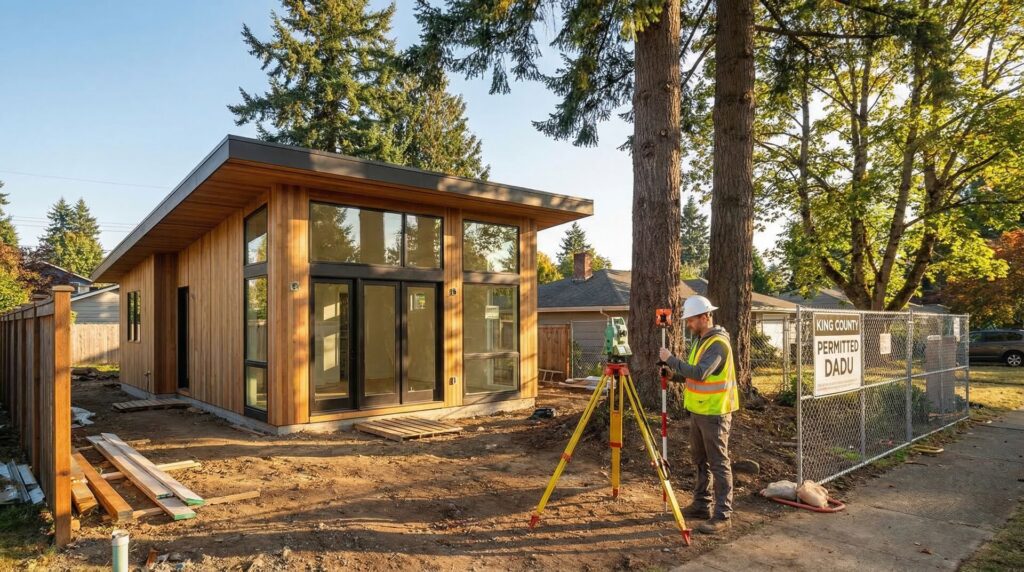
What Are Setbacks and Why Do They Matter?
Setbacks are the minimum distances your DADU must maintain from property lines, streets, and other structures. In King County, setback rules ensure adequate space for fire safety, privacy, drainage, and access. Getting setbacks right during design prevents permit rejections and costly redesigns.
Setbacks are one of the most common reasons DADU permit applications require corrections. Understanding the rules before design starts saves time and money — especially on smaller lots where every foot matters.
Standard DADU Setbacks in Urban King County
For detached ADUs in urban residential zones (R-1 through R-8), King County applies these standard setbacks:
Side Yard Setbacks
- Minimum: 5 feet from each side property line
- Eave projection: Eaves and gutters can project up to 18 inches into the setback area, but the structure wall must maintain the full 5-foot distance
- Corner lots: The side yard facing a street has a larger setback — typically 10–15 feet, matching the front yard requirement for that street
Rear Yard Setbacks
- Minimum: 5 feet from the rear property line
- Alley-adjacent: If your property backs to an alley, the setback is measured from the property line, not the alley edge
- Decks and stairs: Attached decks, porches, and entry stairs count as part of the structure and must comply with setback requirements
Front Yard Setbacks
- Primary front: DADUs must maintain the same front yard setback as required for the primary residence — typically 20 feet in most R zones
- Most DADUs avoid this: Since DADUs are usually placed behind the primary home, the front setback rarely applies
- Exception: Flag lots or through-lots with frontage on two streets may have front yard setbacks on multiple sides
Setbacks in Rural King County
Rural zones (RA-2.5, RA-5, RA-10) have larger setbacks that reflect the character of these areas:
- Side yards: 10 feet minimum (RA-2.5) to 30 feet (RA-10)
- Rear yard: 10–30 feet depending on zone
- Front yard: 20–30 feet from the road right-of-way
Rural lots are typically large enough that setbacks don’t significantly constrain DADU placement. The bigger factors are usually septic system locations and access.
Height Setbacks and Limits
In addition to horizontal setbacks, King County regulates DADU height — and in some zones, height decreases as you build closer to property lines:
- Base height limit: Varies by zone — typically 30–35 feet in urban zones
- DADUs near property lines: A DADU at the minimum 5-foot setback may be subject to reduced height limits to protect neighbor privacy and light access
- Two-story DADUs: May require increased setbacks in some zones to mitigate privacy and shadow impacts
If you’re considering a two-story DADU, height setback interactions become especially important.
What Counts as Part of the Structure
Understanding what “counts” when measuring setbacks prevents common errors:
Included in Setback Measurement
- All exterior walls
- Covered porches and decks attached to the DADU
- Entry stairs and landings
- Bay windows and bump-outs
- Chimneys
Typically Excluded or Have Reduced Requirements
- Roof eaves (up to 18-inch projection typically allowed)
- Gutters and downspouts
- Mechanical equipment (may have separate setback requirements)
- Detached structures under a certain size (like a small shed)
Setback Challenges on Small Lots
On lots under 5,000 square feet, setbacks can severely limit where — and how large — a DADU can be. Common challenges include:
- Narrow lots: Two 5-foot side setbacks on a 40-foot-wide lot leave only 30 feet of buildable width — minus the primary home’s width
- Primary home placement: If the primary home is centered on the lot, the remaining space behind may be too narrow for a DADU after applying side setbacks
- Access requirements: Construction equipment and future maintenance need adequate access, which further constrains placement
Our floor plan guide for small lots addresses these challenges with specific design strategies.
Setback Variances
If your property’s constraints make standard setbacks impossible while still allowing a reasonably sized DADU, you may be able to request a setback variance from King County.
- What it requires: Demonstration that strict application of setbacks creates an undue hardship unique to your property — not just inconvenience
- Process: Formal application, public notice to neighbors, and a hearing before the hearing examiner
- Timeline: Adds 3–6 months to the permit process
- Cost: Application fees plus design costs for the variance request
- Success rate: Varies. Variances for modest reductions with minimal neighbor impact have the best outcomes
Variances should be a last resort. Good design that works within standard setbacks is almost always faster and cheaper.
Tips for Working With Setbacks
- Get a survey first. Never design based on assumed property lines. Fences, landscaping, and apparent boundaries are often inaccurate.
- Design from the setbacks in. Start by mapping the buildable area, then design the DADU to fit — not the other way around.
- Consider a compact footprint. A two-story DADU can maximize square footage while staying within a tight buildable area.
- Account for all projections. Stairs, decks, eaves, and overhangs all affect setback compliance.
- Check zone-specific rules. Standard setbacks are a starting point — your specific zone may have additional requirements.
APEX DADU Designs Within Your Setbacks
Setback compliance is fundamental to every DADU design we produce. APEX DADU starts every project with a site survey and setback analysis — before pen touches paper. The result: designs that maximize your buildable space while meeting every King County requirement.
Contact APEX DADU for a setback and site analysis

Leave a Reply